Cybercriminals Exploit Checkpoint’s Driver in a BYOVD Attack!

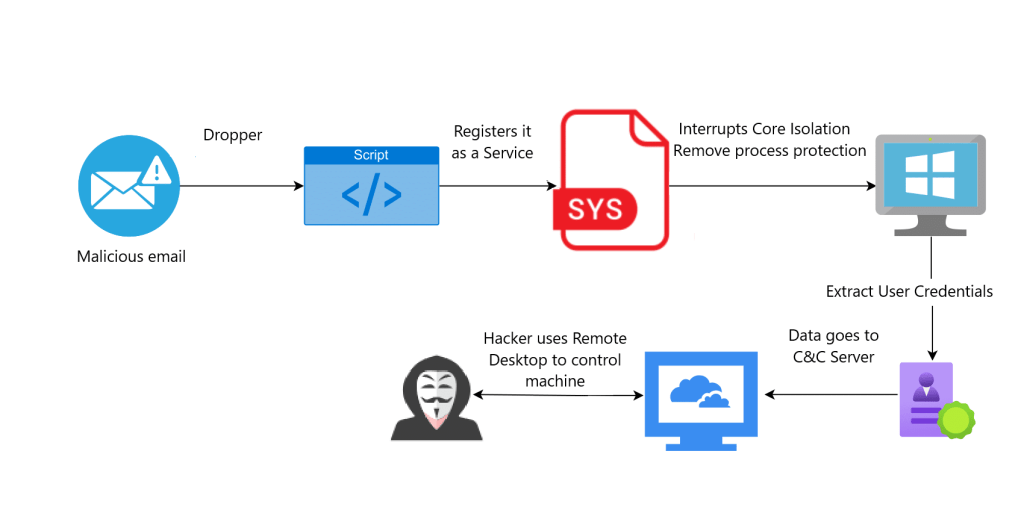
A sophisticated Cyber attack recently observed by Venak Security demonstrated how threat actors exploited vulnerabilities in vsdatant.sys, a kernel-level driver used by Checkpoint’s ZoneAlarm antivirus software. Originally released in 2016, this driver became the target of a Bring Your Own Vulnerable Driver (BYOVD) attack, allowing attackers to elevate privileges and bypass critical Windows security features such as Memory Integrity and extract sensitive data from compromised systems.

As vsdatant.sys operates with high-level kernel privileges, attackers were able to exploit its vulnerabilities, bypassing security protections and antivirus software, and gaining full control of the infected machines.

Exploiting vsdatant.sys: Bypassing Memory Integrity

Windows’ Memory Integrity feature is designed to protect critical system processes by isolating them in a virtualized environment, making it harder for attackers to tamper with or inject malicious code.

Think of it like a security guard inside a locked booth. This isolated environment prevents the memory integrity feature from being tampered with by an attacker. A program that wants to run a piece of code which may be dangerous has to pass the code to memory integrity inside that virtual booth so that it can be verified.

However, the attack observed by Venak Security showed that a vulnerable driver, such as vsdatant.sys, could bypass this powerful defense.

The “Bring Your Own Vulnerable Driver” (BYOVD) technique has become a favored technique within Cyber Criminal groups to disable EDR products. This tactic involves bringing vulnerable drivers onto compromised systems and leveraging them to execute malicious code at the kernel level. By default, 64-bit versions of Windows 10 and later will load a kernel-mode driver only if the kernel can verify the driver signature. Hackers abuse digitally signed but vulnerable drivers by bringing them onto the systems and using them to terminate critical AV or EDR processes, enabling them to operate undetected in the compromised environment.

By exploiting flaws in vsdatant.sys, attackers were able to gain elevated privileges within the system’s kernel, effectively disabling Memory Integrity. Once these defenses were bypassed, attackers had full access to the underlying system, the attackers were able to access sensitive information such as user passwords and other stored credentials. This data was then exfiltrated, opening the door for further exploitation.
The attackers also established a Remote Desktop Protocol (RDP) connection to the infected systems, enabling them to maintain persistent access to the compromised machines.

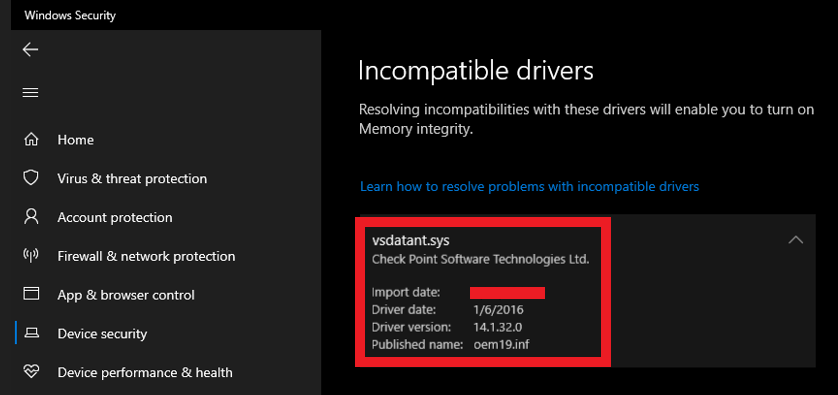
During our investigation, we have noticed that since the device driver had a valid signature, our customer’s EDR ignored this attack and flagged it as safe.

Here is how this attack is implemented:

We were able to replicate the attack and show how hackers implemented it. Watch our video here:

Vulnerable Driver Information

Name: Vsdatant.sys

Version: 14.1.32.0

MD5 Hash: 190fe0ce4d43ad8eed97aaa68827e2c6

The latest version of vsdatant.sys is not Vulnerable.

Summary:

The Vendor has already advised regarding this issue.

How can you prevent these types of attacks?

Contact us via email to request a free consultation.

info@venaksecurity.com

33 responses to “Cybercriminals Exploit Checkpoint’s Driver in a BYOVD Attack!”

  1. […] such as Memory Integrity and extract sensitive data from compromised systems, Venak Security said in a new report shared with Cyber security […]

  2. […] the report, Bagheri noted that vsdatant.sys version 14.1.32.0, launched in 2016, has several vulnerabilities, […]

  3. […] the report, Bagheri noted that vsdatant.sys version 14.1.32.0, launched in 2016, has several vulnerabilities, […]

  4. […] “As vsdatant.sys operates with high-level kernel privileges, attackers were able to exploit its vulnerabilities, bypassing security protections and antivirus software, and gaining full control of the infected machines,” the company said. […]

  5. […] “As vsdatant.sys operates with high-level kernel privileges, attackers have been capable of exploit its vulnerabilities, bypassing safety protections and antivirus software program, and gaining full management of the contaminated machines,” the corporate said. […]

  6. […] “As vsdatant.sys operates with high-level kernel privileges, attackers were able to exploit its vulnerabilities, bypassing security protections and antivirus software, and gaining full control of the infected machines,” the company said. […]

  7. […] “Since vsdatant.Sys works with high -level core privileges, attackers were able to use their vulnerabilities, surpassing safety and antivirus software, as well as receiving full control over infected machines, company company company – Note. […]

  8. […] the report, Bagheri noted that vsdatant.sys version 14.1.32.0, launched in 2016, has several vulnerabilities, […]

  9. […] “As vsdatant.sys operates with high-level kernel privileges, attackers were able to exploit its vulnerabilities, bypassing security protections and antivirus software, and gaining full control of the infected machines,” the company said. […]

  10. […] “As vsdatant.sys operates with high-level kernel privileges, attackers were able to exploit its vulnerabilities, bypassing security protections and antivirus software, and gaining full control of the infected machines,” the company said. […]

  11. […] “As vsdatant.sys operates with high-level kernel privileges, attackers were able to exploit its vulnerabilities, bypassing security protections and antivirus software, and gaining full control of the infected machines,” the company said. […]

  12. […] “Como vsdatant.sys opera con privilegios de núcleo de alto nivel, los atacantes pudieron explotar sus vulnerabilidades, evitando las protecciones de seguridad y el software antivirus, y obteniendo el control total de las máquinas infectadas”, la compañía dicho. […]

  13. […] “As vsdatant.sys operates with high-level kernel privileges, attackers were able to exploit its vulnerabilities, bypassing security protections and antivirus software, and gaining full control of the infected machines,” the company stated. […]

  14. […] the report, Bagheri noted that vsdatant.sys version 14.1.32.0, launched in 2016, has several vulnerabilities, […]

  15. […] “As vsdatant.sys operates with high-level kernel privileges, attackers were able to exploit its vulnerabilities, bypassing security protections and antivirus software, and gaining full control of the infected machines,” the company said. […]

  16. […] “As vsdatant.sys operates with high-level kernel privileges, attackers were able to exploit its vulnerabilities, bypassing security protections and antivirus software, and gaining full control of the infected machines,” the company said. […]

  17. […] “As vsdatant.sys operates with high-level kernel privileges, attackers were able to exploit its vulnerabilities, bypassing security protections and antivirus software, and gaining full control of the infected machines,” the company said. […]

  18. […] driver associated with Checkpoint’s ZoneAlarm product has been leveraged by threat actors to escalate privileges and bypass Windows security features. Venak Security […]

  19. […] “Comme vsdatant.sys fonctionne avec des privilèges de noyau de haut niveau, les attaquants ont pu exploiter ses vulnérabilités, contourner les protections de sécurité et les logiciels antivirus et prendre le contrôle total des machines infectées”, la société dit. […]

  20. […] per Venak Security’s research, the attack starts with a malicious email containing a Dropper, which downloads and executes a […]

  21. […] “As vsdatant.sys operates with high-level kernel privileges, attackers were able to exploit its vulnerabilities, bypassing security protections and antivirus software, and gaining full control of the infected machines,” the company said. […]

  22. […] the report, Bagheri noted that vsdatant.sys version 14.1.32.0, launched in 2016, has several vulnerabilities, […]

  23. […] per Venak Safety’s analysis, the assault begins with a malicious e-mail containing a Dropper, which downloads and executes a […]

  24. […] per Venak Security’s research, the attack starts with a malicious email containing a Dropper, which downloads and executes a […]

  25. […] Şirket, “Vsdatant.sys yüksek seviyeli çekirdek ayrıcalıklarıyla faaliyet gösterdiğinden, saldırganlar güvenlik açıklarını kullanabildiler, güvenlik korumalarını ve antivirüs yazılımını atlayabildiler ve enfekte makinelerin tam kontrolünü kazandı.” söz konusu. […]

  26. […] per Venak Security’s research, the attack starts with a malicious email containing a Dropper, which downloads and executes a […]

  27. […] “As vsdatant.sys operates with high-level kernel privileges, attackers were able to exploit its vulnerabilities, bypassing security protections and antivirus software, and gaining full control of the infected machines,” the company said. […]

  28. […] per Venak Security’s research, the attack starts with a malicious email containing a Dropper, which downloads and executes a […]

  29. […] Cybercriminals Exploit Checkpoint’s Driver in a BYOVD Attack!  […]

  30. […] Cybercriminals Exploit Checkpoint’s Driver in a BYOVD Attack!  […]

  31. […] the report, Bagheri noted that vsdatant.sys version 14.1.32.0, launched in 2016, has several vulnerabilities, […]

  32. […] the report, Bagheri noted that vsdatant.sys version 14.1.32.0, launched in 2016, has several vulnerabilities, […]

  33. […] Venak Security reported exploitation of a separate vulnerability in the ZoneAlarm driver from Check Point. In this case, […]

Leave a Reply to Cybercriminals Exploit CheckPoint Driver Flaws in Malicious Campaign | AI PRO TribeCancel reply

Spam-free subscription, we guarantee. This is just a friendly ping when new content is out.

← Back

Thank you for your response. ✨

Discover more from Venak Security

Subscribe now to keep reading and get access to the full archive.

Continue reading